
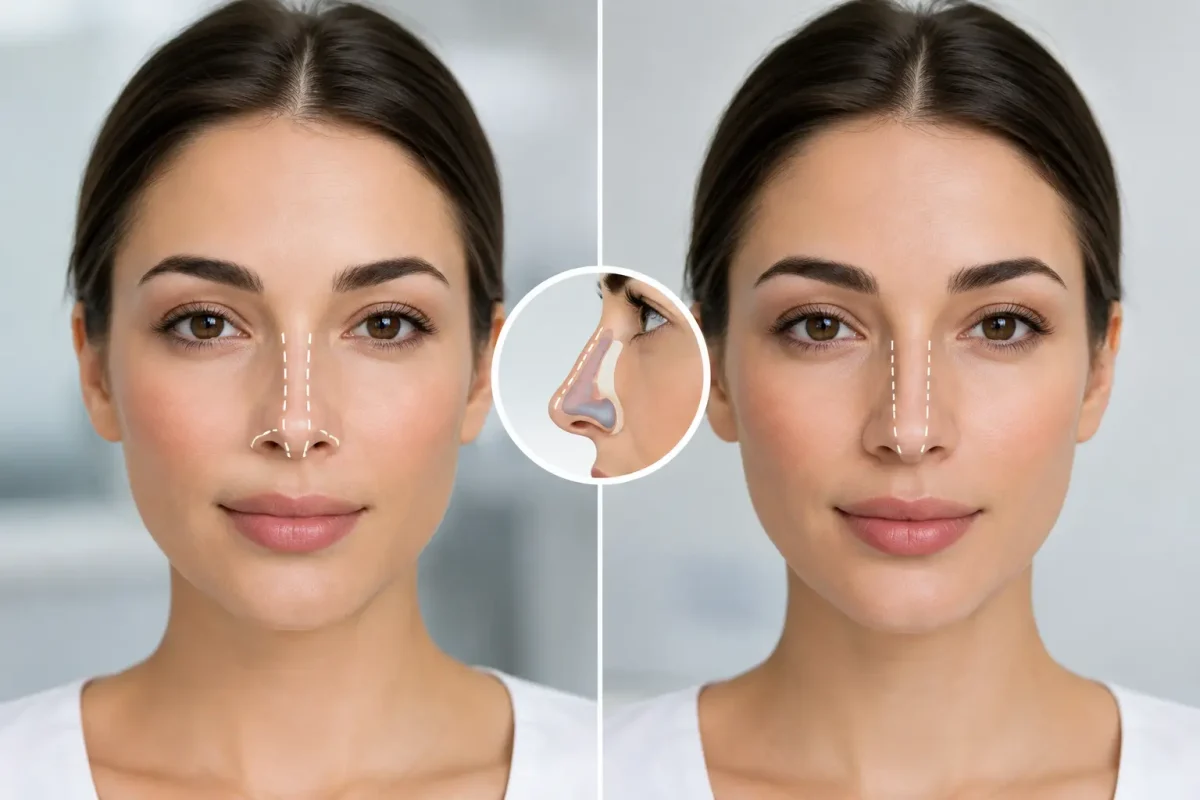
A rhinoplasty plan should not begin with a debate over incision placement. It should begin with the nose itself: its skin thickness, cartilage strength, breathing function, relationship to the chin and cheeks, and the changes needed to preserve facial identity. In the conversation around open versus closed rhinoplasty, one approach is not inherently better. Each gives the surgeon a different way to safely and precisely address the anatomy in front of them.
For patients considering nasal refinement in Monmouth County or Manhattan, the most useful question is not, “Which method has less scarring?” It is, “Which approach gives my surgeon the right level of visibility and control for the result I want?”
What Is Closed Rhinoplasty?
Closed rhinoplasty is performed through incisions hidden inside the nostrils. The surgeon works through these internal openings to reshape bone, cartilage, or soft tissue without making an incision across the columella, the narrow strip of skin between the nostrils.
This technique may be appropriate when the planned changes are relatively focused. For example, a patient may want to smooth a dorsal hump, narrow certain portions of the nasal bones, make a measured tip adjustment, or improve a mild asymmetry. Because the skin of the nasal tip is not lifted in the same way as it is during an open procedure, some patients experience less initial tip swelling.
Closed rhinoplasty is not a shortcut or a lesser operation. It requires a detailed understanding of nasal anatomy and careful work in a more limited surgical field. In experienced hands, it can produce refined, natural-looking changes with no external incision.
Potential Advantages of the Closed Approach
The most visible benefit is that all incisions remain inside the nose. For a suitable candidate, closed rhinoplasty can also mean less soft-tissue dissection and, in some cases, a somewhat quicker resolution of early swelling. Surgery may take less time when the correction is straightforward.
That said, a hidden incision should never be the sole reason to select a technique. A well-healed columellar incision from open rhinoplasty is typically extremely discreet. Choosing a closed approach when the underlying structure requires broader access can compromise the precision that a complex nose deserves.
What Is Open Rhinoplasty?
Open rhinoplasty uses internal nostril incisions plus a small incision across the columella. This allows the surgeon to gently elevate the nasal skin and directly visualize the framework of cartilage and bone.
With the structure exposed, the surgeon can assess asymmetries, cartilage weakness, previous scar tissue, and the relationship between the tip-supporting elements with exceptional clarity. This direct view is particularly valuable when changes must be highly controlled rather than simply reductive.
Open rhinoplasty is commonly recommended for significant tip reshaping, crooked noses, structural grafting, breathing-related reconstruction, congenital asymmetry, and revision rhinoplasty. It can also be the more predictable option for patients with thicker skin, more complex goals, or a history of nasal trauma.
Why Visibility Can Matter
The nose is not a collection of isolated features. Reducing a hump can change tip projection. Narrowing the bridge can alter how the tip appears. Correcting a deviation may require support grafts to maintain both alignment and airflow over time.
An open approach enables the surgeon to see these relationships directly while placing sutures, refining cartilage, or securing graft material. This can be especially meaningful when the goal is durable structural support, not simply a smaller nose. Skeletal expertise meets surgical artistry when the plan accounts for the internal architecture that supports the visible result.
Open Versus Closed Rhinoplasty: The Meaningful Differences
The central difference between open and closed rhinoplasty is surgical access. Open rhinoplasty provides broad visualization of the nasal framework. Closed rhinoplasty relies on internal access and specialized techniques performed without lifting the nasal skin.
The trade-offs extend beyond the incision. Open rhinoplasty generally involves more tip swelling in the early recovery period, and final refinement may take longer to reveal itself. The small external incision also requires routine scar care, although it usually fades remarkably well. In exchange, the surgeon has greater ability to make precise structural modifications in complex cases.
Closed rhinoplasty may offer a shorter operation and less early swelling for selected patients. However, it is not ideal for every type of correction. Extensive tip work, major asymmetry, cartilage grafting, or reconstruction after a prior rhinoplasty may call for the visibility and control of an open technique.
Neither method guarantees a better aesthetic outcome by itself. A beautiful result depends on sound planning, careful tissue handling, stable support, and an understanding of how the nose belongs within the full face.
Who May Be a Candidate for Each Approach?
A primary rhinoplasty patient seeking modest bridge refinement with a stable, well-defined tip may be a good candidate for a closed procedure. So may someone whose goals can be achieved without extensive grafting or major repositioning of the tip cartilages.
An open procedure may be more appropriate for a patient with a bulbous or poorly supported tip, a noticeably crooked nose, a significant deviation of the septum, or breathing concerns. It is also often favored for revision surgery, where prior scar tissue and altered anatomy can make a direct view essential.
Skin quality matters, too. Thicker nasal skin can mask subtle changes, while thin skin may reveal minor contour irregularities. The strength of the cartilage, the width of the nostrils, facial proportions, ethnicity, and prior injury all influence planning. The right technique is determined through examination, not a one-size-fits-all preference.
What Happens During Rhinoplasty Surgery?
Rhinoplasty is typically performed under anesthesia in an accredited surgical setting. After creating the appropriate incisions, the surgeon reshapes the nasal framework according to the treatment plan. This may involve reducing a hump, refining the tip cartilages, straightening the septum, narrowing nasal bones, or adding small cartilage grafts for contour and support.
Cartilage used for grafting may come from the septum, the ear, or, in more complex reconstruction, the rib. Grafts are not a sign that a nose is being made larger. Often, they provide the support needed to create a more balanced tip, improve airflow, or prevent unwanted changes as healing progresses.
At the end of surgery, the incisions are closed and a splint is commonly placed over the bridge. Internal splints may be used when septal work or significant structural correction has been performed.
Preparing for Surgery With Confidence
Preparation begins with an honest conversation about what is realistically achievable. Patients should bring photographs that illustrate preferences, but they should not expect another person’s nose to translate directly to their own face. The most successful plan respects individual anatomy and aims for harmony rather than trend-driven perfection.
Before surgery, patients may need medical clearance, laboratory testing, and a review of medications and supplements. Nicotine should be stopped well in advance because it can impair blood flow and healing. Medications that increase bleeding risk may need to be adjusted only under guidance from the prescribing clinician and surgical team.
It also helps to arrange a calm recovery space, easy meals, prescribed medications, and assistance for the first night. Planning time away from work and social obligations reduces pressure during the early healing period.
Recovery: What Patients Can Expect
Most patients have their external splint removed at about one week. Bruising and swelling around the eyes usually improve substantially over the following one to two weeks, though individual recovery varies. Many people feel comfortable returning to professional settings after roughly 10 to 14 days, particularly with strategic makeup if desired.
The nose will continue to change long after the splint comes off. Bridge swelling settles earlier, while the tip can remain firm or swollen for several months. With open rhinoplasty, tip definition may take a year or longer to fully mature, especially in patients with thicker skin or extensive structural work.
During early recovery, patients should avoid strenuous exercise, bending with the head down, contact risk, and glasses resting on the bridge until cleared by their surgeon. Sleeping with the head elevated and protecting the nose from sun exposure can support a smoother healing process.
Temporary congestion is common, particularly when internal swelling or septal surgery is involved. Pain is generally manageable and often described as pressure rather than sharp discomfort. Persistent worsening pain, fever, unusual drainage, or significant bleeding should be reported promptly.
The Best Rhinoplasty Is the One Planned for Your Anatomy
A consultation should leave you with more than a recommendation for open or closed surgery. You should understand what your surgeon sees in your nasal structure, which changes are advisable, what may be limited by anatomy, and how the plan protects both appearance and function.
Dr. Manolis G. Manolakakis approaches rhinoplasty with the perspective of a dual board-certified facial and maxillofacial surgeon, particularly valuable when aesthetic goals intersect with structural complexity. The conversation should feel personal, pressure-free, and grounded in the outcome that matters most: a nose that looks naturally at home on your face.
The right decision is rarely about choosing the smallest incision. It is about choosing a thoughtful surgical plan that gives you the best chance of lasting balance, comfortable breathing, and confidence that still feels entirely like you.