
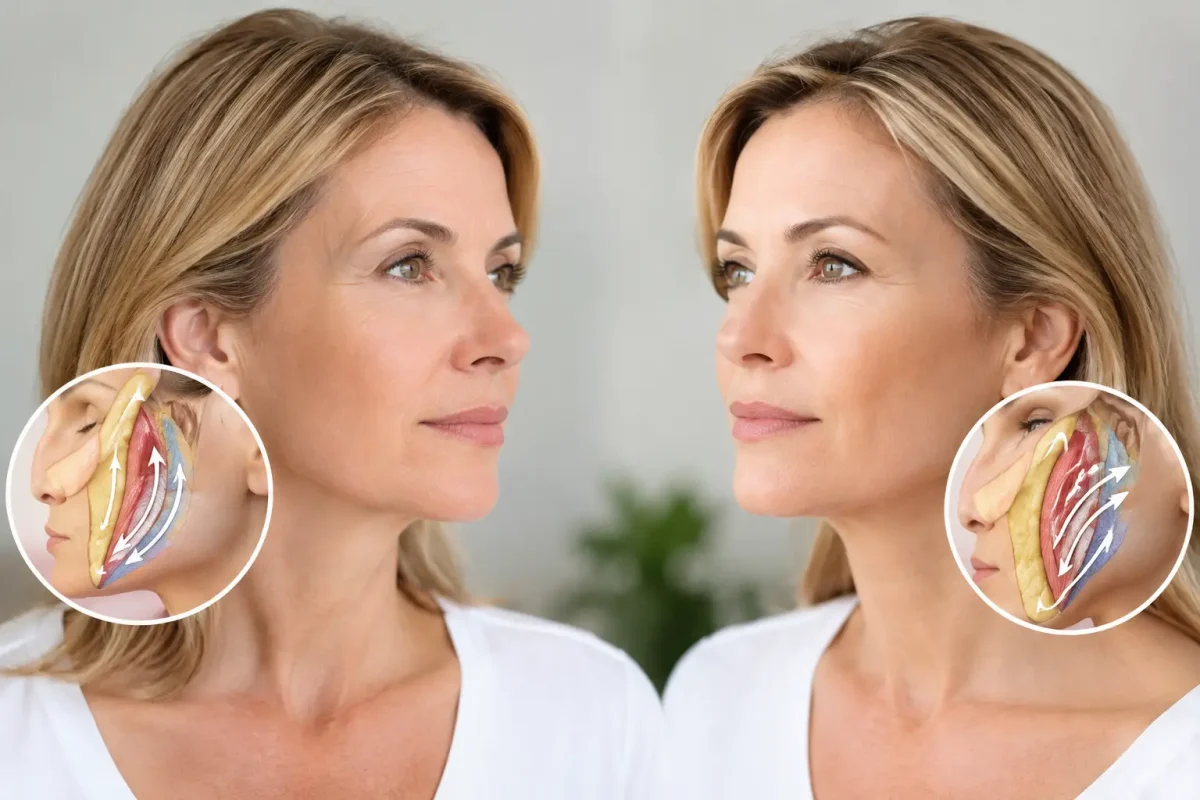
A facelift should not make someone look like a different person. It should restore a more rested, balanced version of the face while respecting the features, expression, and identity that make it unmistakably theirs. For patients considering a deep plane versus SMAS facelift, the best choice is rarely about choosing the newest-sounding technique. It is about matching the surgical approach to the anatomy beneath the skin, the areas of concern, and the degree of rejuvenation desired.
Both approaches can produce elegant, natural-looking results in the hands of a qualified facial surgeon. They also share a common goal: repositioning the deeper support structures of the face rather than simply pulling the skin tighter. The distinction lies in how the surgeon works with those layers and which areas can be most effectively improved.
What Is a SMAS Facelift?
The SMAS, or superficial musculoaponeurotic system, is a fibrous layer of tissue beneath the facial skin. It is connected to the muscles and soft tissues that influence the cheeks, jawline, and neck. As the face ages, the SMAS and surrounding tissues can descend, contributing to jowling, flattening through the midface, and deeper folds around the mouth.
During a SMAS facelift, the skin is carefully elevated to provide access to this deeper layer. The surgeon then tightens, folds, lifts, or repositions the SMAS before gently redraping the skin. The skin is trimmed only as needed, without relying on excessive skin tension to create the result.
SMAS facelift techniques are not one single operation. A surgeon may use SMAS plication, imbrication, or a SMAS flap depending on the patient’s tissue quality, degree of laxity, and facial anatomy. This flexibility makes SMAS-based lifting a valuable option for many patients, particularly those with early to moderate descent in the lower face and neck.
What a SMAS Facelift Can Address
A well-planned SMAS facelift can improve jowls, restore a cleaner jawline, reduce laxity in the lower cheeks, and refine the transition between the face and neck. It may be performed with a neck lift when banding, excess neck skin, or submental fullness also require correction.
For the right patient, the outcome can be subtle and enduring. However, a conventional SMAS approach may have more limited access to the deeper midface compared with a deep plane technique. That matters most when cheek descent and pronounced nasolabial folds are central concerns.
What Is a Deep Plane Facelift?
A deep plane facelift also lifts the deeper foundation of the face, but it is performed beneath the SMAS in a specific tissue plane. This allows the surgeon to release selected retaining ligaments that tether descended facial tissues in place. Once those attachments are carefully released, the cheek and jawline tissues can be repositioned as a more unified unit.
This approach is especially useful when aging has created heaviness in the midface, flattening of the cheek, deep nasolabial folds, and loss of definition along the jawline. Rather than relying on skin tension, the procedure is designed to restore soft tissue to a more youthful position.
A deep plane facelift requires detailed knowledge of facial anatomy. Important nerves, vessels, ligaments, and muscular structures are located within and around the surgical field. Skeletal expertise meets surgical artistry when the surgeon understands not only where tissue has descended, but why it has descended and how to reposition it safely in harmony with the patient’s underlying facial framework.
Why Deep Plane Results Can Look Natural
The term deep plane has become popular, but it should not be treated as a promise of a particular look. The natural quality of a facelift comes from appropriate vector of lift, conservative skin tension, thoughtful incision placement, and individualized planning.
That said, lifting the cheek and lower face as a connected layer can create a smooth transition from the lower eyelid and cheek into the jawline. For patients with significant midface descent, this may provide a more complete correction than an approach focused primarily on the lower face.
Deep Plane Versus SMAS Facelift: The Meaningful Differences
The most useful comparison is not better versus worse. It is access and indication.
A SMAS facelift works at the SMAS layer and can be highly effective for lower-face and neck rejuvenation. It may be an appropriate choice for patients whose primary concerns are jowls, mild to moderate sagging, and loss of jawline definition. Depending on the technique, it can offer excellent longevity with a recovery profile that is familiar and manageable for many facelift candidates.
A deep plane facelift works beneath the SMAS and releases deeper facial attachments to mobilize the midface and lower face together. It may be particularly beneficial for patients with heavier cheeks, deeper smile lines, more pronounced tissue descent, or a desire for greater midface elevation. It is not automatically necessary for every patient, even when a patient is seeking a significant improvement.
The best technique also depends on skin thickness, facial width, bone structure, prior surgery, scar tissue, neck anatomy, degree of volume loss, and healing history. A patient with a slender face and volume depletion may benefit from facial fat grafting in addition to lifting. Someone with a full neck or prominent platysmal bands may need a neck lift as part of a comprehensive plan. In some cases, an eyelid procedure or brow lift better addresses the area a patient finds most concerning.
Preparation Begins With Facial Analysis
An excellent facelift is planned before the first incision. During a consultation, a facial specialist should evaluate the face from multiple angles and assess skin elasticity, soft tissue descent, facial proportions, neck contour, bone structure, and the relationship between the cheeks, jawline, and chin.
Patients should be ready to discuss medical conditions, medications, supplements, nicotine use, previous facial procedures, and any history of poor scarring or delayed healing. Nicotine products are particularly relevant because they can compromise blood flow and increase healing risks. Blood-thinning medications and supplements may need to be adjusted under the guidance of the prescribing physician and surgical team.
Preparation also includes practical planning. Most patients should arrange help at home for the first day or two, prepare comfortable recovery essentials, and protect adequate time away from work and social commitments. A pressure-free consultation should make room for questions about technique, scars, anesthesia, recovery, and what can realistically be achieved.
Recovery After a SMAS or Deep Plane Facelift
Both procedures are surgical operations, and recovery deserves respect. Bruising, swelling, tightness, numbness, and temporary asymmetry are common in the early healing period. The first week generally involves the most visible swelling and the greatest need for rest, head elevation, and careful incision care.
Many patients feel ready for light daily activity within one to two weeks, although appearing fully presentable for an important event can take longer. Bruising often improves substantially by two weeks, while residual swelling may continue to settle over several weeks to months. Deep plane procedures are not necessarily defined by a longer recovery, but the exact course varies with the extent of surgery, whether a neck lift or fat grafting is included, and each patient’s healing pattern.
Strenuous exercise, heavy lifting, and activities that elevate blood pressure should be avoided until cleared by the surgeon. Follow-up visits are essential because careful monitoring supports proper healing and allows the team to address questions early.
Safety and Expectations Matter More Than Labels
A facelift carries real surgical considerations, including bleeding, hematoma, infection, scarring, temporary or, rarely, more persistent nerve weakness, skin healing concerns, and anesthesia-related risks. These risks are uncommon but should be discussed clearly rather than minimized.
Technique alone does not determine safety or quality. The surgeon’s training, knowledge of facial anatomy, precision, judgment, and willingness to recommend a less extensive procedure when appropriate all matter. This is especially relevant for patients who have had a prior facelift, facial trauma, significant weight change, or previous injectable treatments that may affect tissue planes.
At Advanced Facial Surgery, Dr. Manolis G. Manolakakis approaches facial rejuvenation with individualized planning informed by both aesthetic refinement and advanced reconstructive knowledge. The aim is not a standardized deep plane or SMAS result. It is a result that looks coherent with the patient’s face, age, and personal goals.
The right facelift should feel like a considered decision, not a trend to chase. A thoughtful conversation with an experienced facial surgeon can clarify which approach respects your anatomy and gives you the clearest path toward looking refreshed, comfortable, and authentically yourself.