
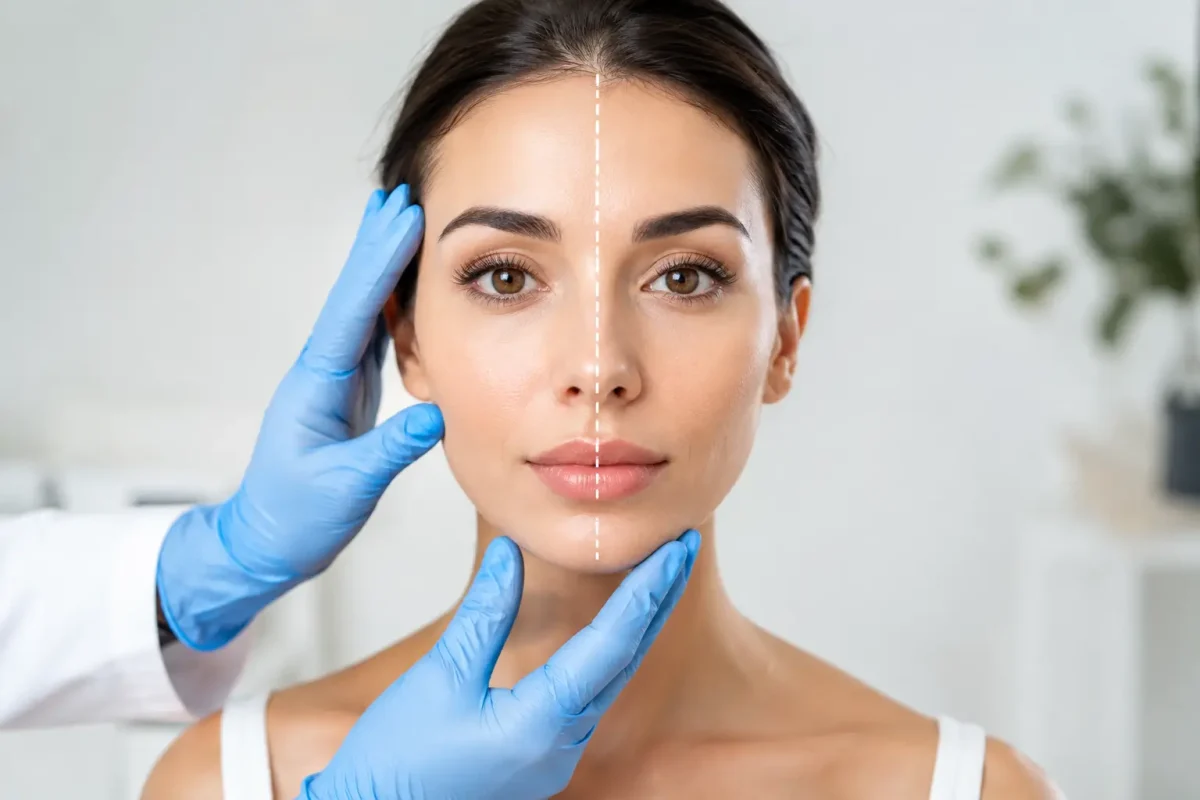
Most faces are naturally uneven. One eyebrow may sit slightly higher, one cheek may carry more volume, or the jawline may appear sharper on one side. These small differences are part of what makes a face individual. Facial asymmetry surgery becomes a consideration when imbalance is more noticeable, affects function, results from injury or prior surgery, or leaves a patient feeling that their features do not reflect how they want to look.
The goal is not mathematical symmetry. A perfectly mirrored face can look unnatural. The more meaningful goal is facial harmony: improving proportion among the forehead, eyes, nose, cheeks, lips, jaw, and neck while preserving the features that make a person recognizable.
What Causes Facial Asymmetry?
Facial asymmetry can be present from birth or develop gradually over time. In some patients, the cause is primarily skeletal. The upper or lower jaw may have developed unevenly, the chin may sit off center, or one side of the face may have less projection. In others, the difference is mostly soft tissue related, such as uneven fat volume, muscle activity, skin laxity, or scarring.
A deviated nose can make the entire face appear less balanced, particularly when the nasal bridge, tip, or nostrils pull toward one side. Prior trauma may leave a more complex combination of nasal, orbital, cheekbone, and jaw irregularities. Facial paralysis, congenital conditions, dental bite discrepancies, and the effects of previous surgery can also contribute.
Aging adds another layer. Facial volume loss and tissue descent rarely occur in exactly the same way on both sides. A patient may notice that one jowl is heavier, one eyelid appears more hooded, or one cheek looks flatter. In these cases, the most appropriate treatment may be a facelift, eyelid procedure, fat grafting, or a carefully planned combination rather than surgery on the facial bones.
Facial Asymmetry Surgery Starts With the Cause
The same visible concern can have very different underlying anatomy. That is why a thoughtful evaluation matters more than choosing a procedure from a menu.
During consultation, the surgeon considers the face at rest and in motion, frontal and profile proportions, dental bite, jaw position, nasal airflow, skin quality, volume distribution, and prior procedures or injuries. Photographs are useful, but an in-person examination is essential. For patients with significant jaw imbalance, bite concerns, trauma, or suspected skeletal asymmetry, imaging and coordination with orthodontic or dental specialists may be appropriate.
This process distinguishes a concern that can be improved with a refined cosmetic procedure from one that requires maxillofacial-level planning. It also prevents overtreatment. For example, adding volume to a cheek that appears flat may help in one patient, while another may actually need correction of a jaw imbalance or scar-related tethering.
When the Nose Is the Main Source of Imbalance
Rhinoplasty can improve asymmetry involving a crooked bridge, displaced nasal bones, uneven nostrils, tip deviation, or collapse after injury. However, no nose is perfectly symmetrical, and skin thickness, healing patterns, and the shape of the surrounding face influence what can be achieved.
Revision rhinoplasty requires particularly careful planning. Scar tissue, altered cartilage support, and prior changes to nasal blood supply make this a reconstructive challenge as much as an aesthetic one. The priority is a nose that is balanced, supported, functional, and appropriate for the patient’s face – not one that looks artificially narrow or overcorrected.
When Jaw or Chin Position Drives the Concern
A chin that sits to one side, an uneven lower jaw, or a bite that does not meet properly can affect facial balance from the lower third upward. Depending on the anatomy and severity, treatment may involve chin reshaping or repositioning, facial implants, orthognathic jaw surgery, or a combination of approaches.
Jaw surgery is not a shortcut for mild cosmetic imbalance. It is a significant procedure typically considered when skeletal discrepancy affects function, occlusion, airway considerations, or facial proportion in a meaningful way. It often requires extensive planning and a longer recovery, but it can be transformative for the right candidate because it addresses the foundation rather than masking it.
When Soft Tissue Is the Primary Issue
For asymmetry related to volume, skin laxity, or age-related descent, facial fat grafting can restore softness and contour using a patient’s own fat. Fillers may be useful for select, subtle concerns or as a temporary way to evaluate whether added volume improves balance. Their role is limited when the issue is structural or when repeated product placement begins to obscure natural facial definition.
A facelift or neck lift may be appropriate when one side of the lower face and neck has descended more noticeably. Advanced lifting techniques can reposition deeper facial tissues, rather than simply pulling the skin, to create a more natural and lasting result. Eyelid surgery or brow lifting may help when uneven brow position, upper lid skin, or lower lid support contributes to an imbalanced appearance.
What Results Can Facial Asymmetry Surgery Realistically Achieve?
Facial asymmetry surgery can create a face that reads as more balanced, rested, and proportionate. Patients often describe looking less tired in photographs, feeling more comfortable from certain angles, or no longer focusing on a feature that has long bothered them.
Realistic expectations are essential. Human faces have natural variation in bone structure, muscles, skin elasticity, and healing. Even with meticulous surgical technique, minor asymmetries will remain. Swelling can also be uneven during recovery, especially after rhinoplasty, jaw procedures, or revision surgery. Final refinement may take months, not weeks.
The most successful outcome is usually one that appears unforced. Friends may notice that a patient looks refreshed or more confident without immediately identifying what changed. That is often a better measure of success than chasing identical measurements from one side of the face to the other.
Recovery Depends on the Procedure
Recovery should be planned around the actual treatment, not a generalized idea of facial surgery. A small chin procedure or fat grafting has a very different recovery profile from orthognathic surgery or a complex revision rhinoplasty.
Swelling, bruising, temporary numbness, and activity restrictions are common after many facial procedures. More extensive skeletal surgery may involve dietary modifications, longer time away from work, and structured follow-up. Soft tissue procedures may allow a faster social recovery, although subtle swelling can persist while tissues settle.
Patients should also understand the potential risks, which vary by procedure and may include bleeding, infection, scarring, sensory changes, asymmetry, delayed healing, dissatisfaction with contour, and the possibility of revision. A qualified facial surgeon should discuss these directly, along with the steps taken to reduce them. Safety and transparency are not separate from aesthetic planning – they are part of it.
Choosing the Right Surgical Perspective
Facial balance is not created by treating features in isolation. A narrow focus on one cheek, one nostril, or one side of the jaw can miss the relationship between the face’s skeletal framework and its soft tissue envelope.
For patients with straightforward aesthetic concerns, a focused procedure may be all that is needed. For those with prior trauma, congenital differences, bite issues, or previous surgery, deeper reconstructive and maxillofacial expertise can be especially valuable. The consultation should feel pressure-free and specific to your anatomy, with a clear explanation of what surgery can improve, what it cannot, and whether a nonsurgical option is reasonable.
At Advanced Facial Surgery, this perspective brings skeletal expertise and surgical artistry together, with treatment plans designed around enduring facial harmony rather than a standardized look.
If an asymmetry has occupied too much of your attention, the next step is not deciding which procedure you need. It is having a careful conversation with a facial specialist who can identify the source of the imbalance and help you choose an approach that still looks like you.