
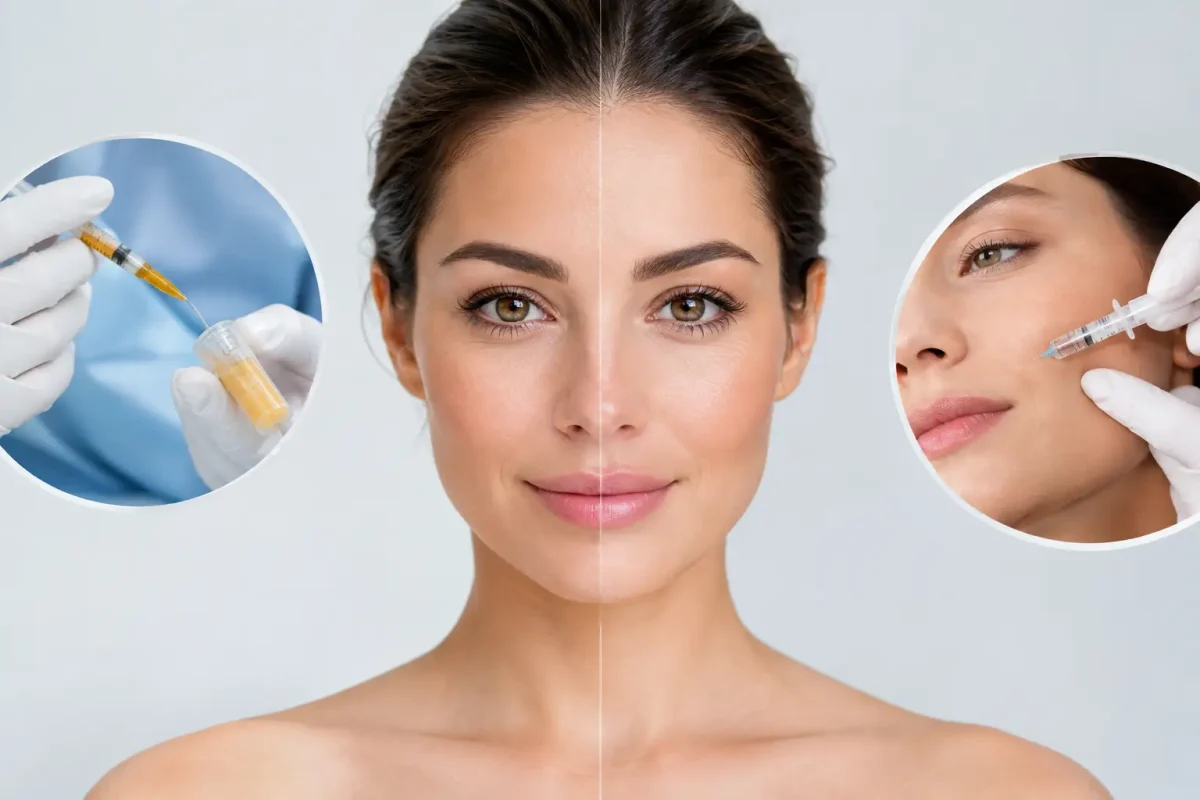
A hollowing under the eyes, a flattening through the cheeks, or a less-defined jawline can make the face appear tired even when you feel well. When considering facial fat grafting vs fillers, the right choice is rarely about which treatment is universally “better.” It is about selecting the approach that respects your anatomy, goals, timeline, and the way your face is likely to age over time.
Both options can restore volume beautifully when used thoughtfully. They differ, however, in the material used, how long results may last, the recovery involved, and the degree of planning required. A facial specialist should assess volume loss in the context of skin quality, bone structure, facial movement, and overall facial harmony rather than treating one isolated crease or hollow.
Facial Fat Grafting vs Fillers: The Fundamental Difference
Dermal fillers are injectable gels, most commonly made of hyaluronic acid, placed beneath the skin to restore contour, soften lines, or enhance selected areas of the face. They are performed in the office, usually require little downtime, and offer an adjustable way to evaluate a change in facial volume.
Facial fat grafting uses your own fat. Fat is gently removed from a donor area, such as the abdomen or thighs, processed, and strategically placed into areas of facial volume loss. Because fat grafting involves harvesting and transferring living tissue, it is a surgical procedure and requires a more involved recovery than injectable filler.
The distinction matters because the face is not a collection of disconnected lines. A refined result depends on restoring proportion between the cheeks, temples, under-eye area, jawline, and mouth. Skeletal expertise meets surgical artistry when volume is placed with a clear understanding of what is beneath the skin and how each facial region supports the next.
When Fillers May Be the Better Choice
Fillers are often an excellent option for patients who want a non-surgical treatment, a faster return to social activities, or a modest and targeted refinement. Hyaluronic acid fillers can be particularly useful for selected concerns in the lips, cheeks, chin, jawline, and folds around the mouth. Depending on the product and area treated, results commonly last from several months to approximately two years.
One meaningful advantage is flexibility. Hyaluronic acid filler can be adjusted over time, and in many circumstances it can be dissolved if needed. That does not mean filler is casual or risk-free. Injection technique, product selection, depth of placement, and a precise understanding of facial blood vessels are essential to safety and a natural result.
Fillers may be especially appropriate if you are still deciding how much correction you want, have a specific area that needs subtle support, or are not ready for surgery. They can also complement surgical facial rejuvenation. For example, carefully selected filler may refine a contour that does not require an operation or provide temporary correction before a larger treatment plan is pursued.
The limitation is that filler is temporary. Repeated appointments and maintenance costs can become significant over the years. Overfilling is another concern, particularly when product is added repeatedly to compensate for diffuse volume loss. A face can begin to look heavier or less defined when treatment focuses only on filling visible hollows rather than restoring balanced support.
When Facial Fat Grafting May Be the Better Choice
Fat grafting is often considered by patients seeking a longer-lasting improvement in facial volume with their own tissue. It can be used to soften temple hollowing, restore cheek fullness, improve transitions around the lower eyelids, and create a more rested appearance around the mouth and jawline. It is frequently performed with a facelift, eyelid surgery, or other facial procedures because these concerns often occur together.
After transfer, some of the grafted fat will establish a blood supply and survive long term. Not all transferred fat survives, and the degree of retention varies from person to person and by treatment area. For that reason, careful technique, conservative planning, and realistic expectations are central to successful fat grafting. A touch-up procedure is occasionally appropriate, particularly when more volume is desired after healing.
Patients often appreciate that fat has a soft, natural quality. It can be especially valuable for broader areas of deflation that would otherwise require substantial amounts of filler. Unlike filler, however, fat grafting is not simply reversible. The goal must be precision from the beginning, with volume placed in a way that preserves natural contours rather than changing the character of the face.
Fat grafting also requires recovery. Swelling and bruising are expected in both the face and donor area, with the most noticeable swelling typically improving over the first few weeks. Subtle refinement continues as the tissues settle. Patients who need an immediate result for an upcoming event may find fillers more practical, while those planning facial surgery or pursuing enduring volume restoration may find fat grafting more appealing.
Comparing Longevity, Recovery, and Control
Neither treatment should be selected based on longevity alone. The most durable option is not automatically the best one if it does not match the area being treated or the patient’s comfort with surgery.
Fillers provide a high degree of immediate control. During an appointment, small amounts can be placed in precise locations, and the result can often be evaluated right away. Mild swelling or bruising may occur, but many patients resume normal activities quickly. Results fade gradually, which allows the treatment plan to evolve as your preferences and facial needs change.
Fat grafting requires more advance planning and a longer healing period, but it can offer lasting correction once transferred fat has stabilized. The result is not judged on the day of surgery. Early swelling can temporarily make the face look fuller than intended, and patience is needed while the final contour develops.
Cost should also be considered in the proper context. Fillers generally have a lower initial cost but require maintenance. Fat grafting typically represents a greater upfront investment due to the surgical process, anesthesia considerations, and recovery, yet it may reduce the need for repeated volume treatments over time. An individualized consultation is the only responsible way to compare value for your particular goals.
Why Anatomy Changes the Recommendation
A sunken midface is not always a simple lack-of-filler problem. It may reflect cheek fat descent, thinning skin, loss of bony support, laxity through the lower eyelids, or a combination of these changes. Adding volume without addressing the underlying cause can produce an artificial or puffy result.
This is why facial rejuvenation benefits from a comprehensive evaluation. A patient with early cheek deflation and good skin quality may be an excellent candidate for conservative filler. Someone with significant jowling, neck laxity, and midface descent may achieve a more harmonious outcome with a facelift and carefully planned fat grafting. For others, a combination of surgical and non-surgical treatments is the most measured approach.
The same principle applies to the under-eye area. It is a delicate region with thin skin, complex anatomy, and a high potential for visible irregularities. Some patients benefit from volume restoration, while others are better served by lower eyelid surgery, skin treatment, or a different strategy entirely. A thoughtful recommendation sometimes means advising against adding volume where it is not likely to improve the problem.
Choosing a Natural-Looking Path Forward
The best treatment plan should leave you looking like yourself, not like a different person with more volume. During a consultation, discuss what bothers you in photographs and in person, how quickly you want to see a change, your tolerance for downtime, and whether you prefer a temporary or potentially longer-lasting approach. Your surgeon should also review prior fillers, prior facial surgery, weight changes, and medical factors that may affect planning.
At Advanced Facial Surgery, recommendations are built around individualized anatomy and long-term facial balance, not a one-size-fits-all volume target. Whether the answer is filler, fat grafting, surgery, or no treatment at all, clarity about the trade-offs helps you move forward with confidence.
A refreshed appearance often comes from restraint: restoring support where it has been lost, preserving your distinctive features, and choosing a plan that will still feel right when the swelling has settled and life returns to normal.